A lot of businesses do not need a fashionable stack. They need a system that works every day, handles real data, supports real users, and does not turn routine maintenance into a budget problem. That is exactly where lamp stack web development continues to make sense.
For companies running customer portals, internal dashboards, ecommerce backends, scheduling systems, reporting tools, or content-driven websites, the LAMP stack offers something newer stacks often do not - a proven foundation with predictable operating costs and a large base of production experience. Linux, Apache, MySQL, and PHP are not exciting because they are new. They are valuable because they keep solving the same business-critical problems well.
Why lamp stack web development still matters
Proven in production for over two decades
There is a tendency in software conversations to treat maturity like a weakness. In practice, maturity is often the reason a system stays maintainable. The LAMP stack has been used for decades in production environments across small businesses, SaaS products, internal enterprise tools, and high-traffic publishing platforms. That history matters when you are making decisions tied to budget, staffing, uptime, and long-term support.
A mature stack usually means better documentation, fewer surprises in deployment, and more established patterns for security, caching, database design, and server management. It also means that when your business needs support six months or three years from now, you are not hunting for specialists in a narrow, fast-shifting ecosystem.
Still the default for PHP-based business applications
That does not mean LAMP is the right answer for every project. If you are building a product that depends on heavy real-time event streaming, ultra-specialized frontend rendering pipelines, or infrastructure choices tightly coupled to another language ecosystem, there may be stronger options. But many organizations are not solving those problems. They need reliable CRUD applications, secure admin interfaces, API integrations, transactional workflows, and database-driven business logic. LAMP remains very good at those jobs.
What the LAMP stack does well
Relational data and structured workflows
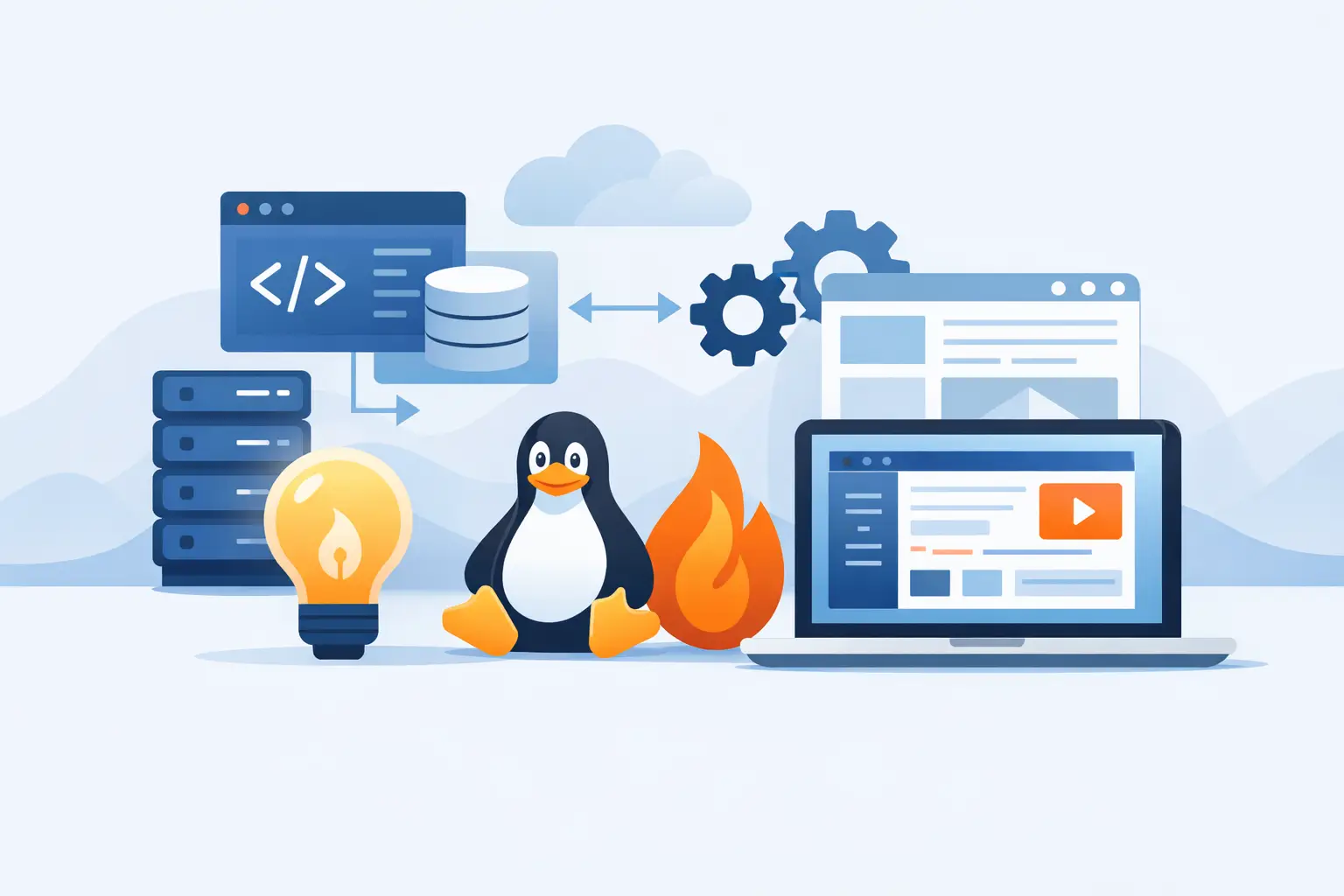
The strength of the stack is not just that its components are common. It is that they work together in a way that is practical for business applications. Linux provides a stable server environment. Apache remains flexible and well understood. MySQL handles structured application data efficiently for a huge range of workloads. PHP is especially effective for web application logic, backend processing, and systems that need to move data between users, databases, and third-party services.
That combination is a strong fit for projects where the application has clear workflows and operational importance. Think of a membership portal, a vendor management dashboard, a service request platform, a quoting system, a learning portal, or a reporting interface layered over existing business data. These are not speculative products. They are systems that support revenue, operations, and staff productivity.
Cost-efficient hosting and deployment
LAMP also supports a disciplined approach to development. A custom web application can be structured cleanly, deployed on predictable infrastructure, integrated with MySQL in a straightforward way, and maintained without requiring a large platform team. For many small to mid-sized businesses, that matters more than using the newest toolset.
Where businesses benefit most
Customer portals and internal tools
The best use cases for lamp stack web development usually involve a clear business process that needs to be improved, replaced, or extended. A company may have an aging internal tool built years ago that still runs daily operations but has become hard to update. Another may have teams relying on spreadsheets and manual approvals because no off-the-shelf software matches the workflow. Others need a customer-facing system tied directly to a database, payment process, inventory feed, or service workflow.
In those situations, the question is not whether the stack looks modern in a pitch deck. The question is whether it can support the application reliably, affordably, and without unnecessary complexity. LAMP often checks those boxes.
Ecommerce and database-driven applications
Ecommerce platforms and other database-driven applications are one of the strongest matches for the stack. A structured product catalog, order history, customer accounts, and inventory levels all map naturally onto MySQL's relational model, while PHP handles checkout logic, payment integration, and the business rules that make a store actually function. This is also where modern PHP web development earns its keep — a well-architected application built on top of LAMP gives you the same dependable infrastructure with cleaner code and far less long-term maintenance risk than an unstructured legacy build.
It is also especially useful in environments where PHP already exists. Many businesses have legacy PHP systems that still matter. Replacing those systems with an entirely different stack can be expensive, risky, and operationally disruptive. In many cases, it is smarter to stabilize, refactor, extend, or rebuild selectively within the same technical family. That approach preserves business continuity while improving code quality, performance, and maintainability.
Cost efficiency without cutting corners
Why the total cost of ownership stays lower
One reason businesses continue choosing LAMP is simple: the economics are often favorable. The core technologies are open source. Hosting and infrastructure options are widely available. Deployment patterns are well established. The pool of developers and administrators familiar with the environment is broad compared with many newer ecosystems.
This matters for organizations that need custom software but still operate within real budget limits. A stable backend system that solves a defined business problem is usually more valuable than a trend-driven build that takes longer to launch and costs more to maintain.
Where cost-cutting actually backfires
That does not automatically make every LAMP project cheap. Poor architecture, rushed code, and weak database design can create expensive problems in any stack. But when the work is handled correctly, LAMP can deliver a strong balance between capability and cost. You are not paying a premium just to support the technology choice itself.
The real trade-offs
When LAMP is not the right choice
No serious engineering decision should ignore trade-offs. LAMP has them, and they should be stated clearly.
There is also the frontend question. Many modern web applications need richer client-side experiences than a traditional server-rendered app provides. That does not make LAMP unsuitable, but it may mean pairing the backend with a JavaScript frontend where appropriate. The right answer depends on the product, the users, and the operational requirements. Not every application needs a complex frontend architecture, but some do.
Database design is another area where trade-offs matter. MySQL is highly capable for many workloads, but application performance depends heavily on schema quality, indexing strategy, query design, and caching decisions. If a system processes high volumes of transactional data or reporting queries, the backend has to be designed with that in mind from the start.
Old PHP vs modern PHP — the difference matters
A LAMP application needs sound architecture to stay maintainable as it grows. The stack is flexible, but flexibility can produce inconsistent codebases if development standards are weak. Some teams assume that because PHP is familiar, any implementation will be easy to support. That is not true. Legacy PHP systems often become difficult because they were built without structure, testing discipline, or separation of concerns. Modern PHP development typically means building on a structured framework like Laravel, which enforces separation of concerns, testing conventions, and security practices that older, ad hoc PHP codebases usually lack — the difference is rarely the language itself, it is the discipline behind how it was used.
What good LAMP development looks like
Engineering discipline over technology hype
A dependable LAMP project is usually defined less by the stack itself and more by the engineering discipline behind it. Good work starts with a clear understanding of the business process. What is the system supposed to do, who uses it, what data matters, and where are the current failures or inefficiencies?
From there, the application should be designed around maintainable backend logic, a sensible database model, and deployment practices that reduce risk. That includes error handling, security hardening, role-based access where needed, backup planning, and a realistic plan for future updates. Mature technology only pays off when the implementation is equally disciplined.
Why specialization matters more than a broad tech stack
This is where specialization matters. A team that works deeply in PHP and MySQL-based systems will usually make better decisions about structure, performance, debugging, and support than a generalist team treating the stack as just another option on a long services list. LAMPProgramming.dev is built around that kind of specialization because many companies do not need a broad agency story. They need experienced engineering focused on a proven stack.
Choosing LAMP for the right reasons
When LAMP is the right technology, not a compromise
If your business needs a custom portal, database-driven website, internal operations tool, backend application, or support for an existing PHP system, LAMP is still a serious option. It is not a compromise stack for companies that cannot afford better technology. In many cases, it is the better technology because it aligns with the actual problem.
What a stable, boring stack actually delivers
The strongest technical decisions usually look boring from the outside. They reduce risk, control cost, and keep the system understandable for the people who will own it over time. That is often exactly what a business needs.
A practical stack is not a step backward when it keeps your web systems stable, maintainable, and useful long after the launch date. If you want to talk specifics, contact us for a LAMP project and we will walk through what a properly engineered system looks like for your business.
Frequently Asked Questions
- Yes. LAMP stack remains widely used in 2025 for business applications, customer portals, ecommerce systems, and internal tools. Modern LAMP development uses PHP frameworks like Laravel which bring clean architecture and fast development to the same proven stack.
- LAMP is used to build dynamic, database-driven web applications — including CRMs, admin dashboards, ecommerce stores, booking systems, and any application requiring structured data, user accounts, and business logic.
- Yes, when properly engineered. Many high-traffic production systems run on LAMP. The key is proper database indexing, caching strategy, query optimisation, and using a PHP framework like Laravel for clean, maintainable code.
- LAMP is the server infrastructure layer — Linux, Apache, MySQL, PHP. Modern frameworks like Laravel run on top of LAMP. Choosing Laravel does not mean abandoning LAMP — it means using the stack with better structure, security, and developer tooling.