If you've heard developers talk about server-side rendering (SSR) and weren't sure whether it applies to your business, this article breaks it down without the jargon — and explains why it matters for SEO in 2025.
What Server-Side Rendering Means
When someone visits a website, their browser receives an HTML document and renders it on screen. How that HTML is generated — and where — defines whether a site uses server-side or client-side rendering.
Client-Side Rendering (CSR)
In a client-side rendered app, the server sends a near-empty HTML file and a large JavaScript bundle. The browser downloads the JavaScript, executes it, and then builds the page. From a user's perspective, they often see a blank screen or loading spinner before content appears.
React apps and Vue.js apps built without SSR use this model by default.
Server-Side Rendering (SSR)
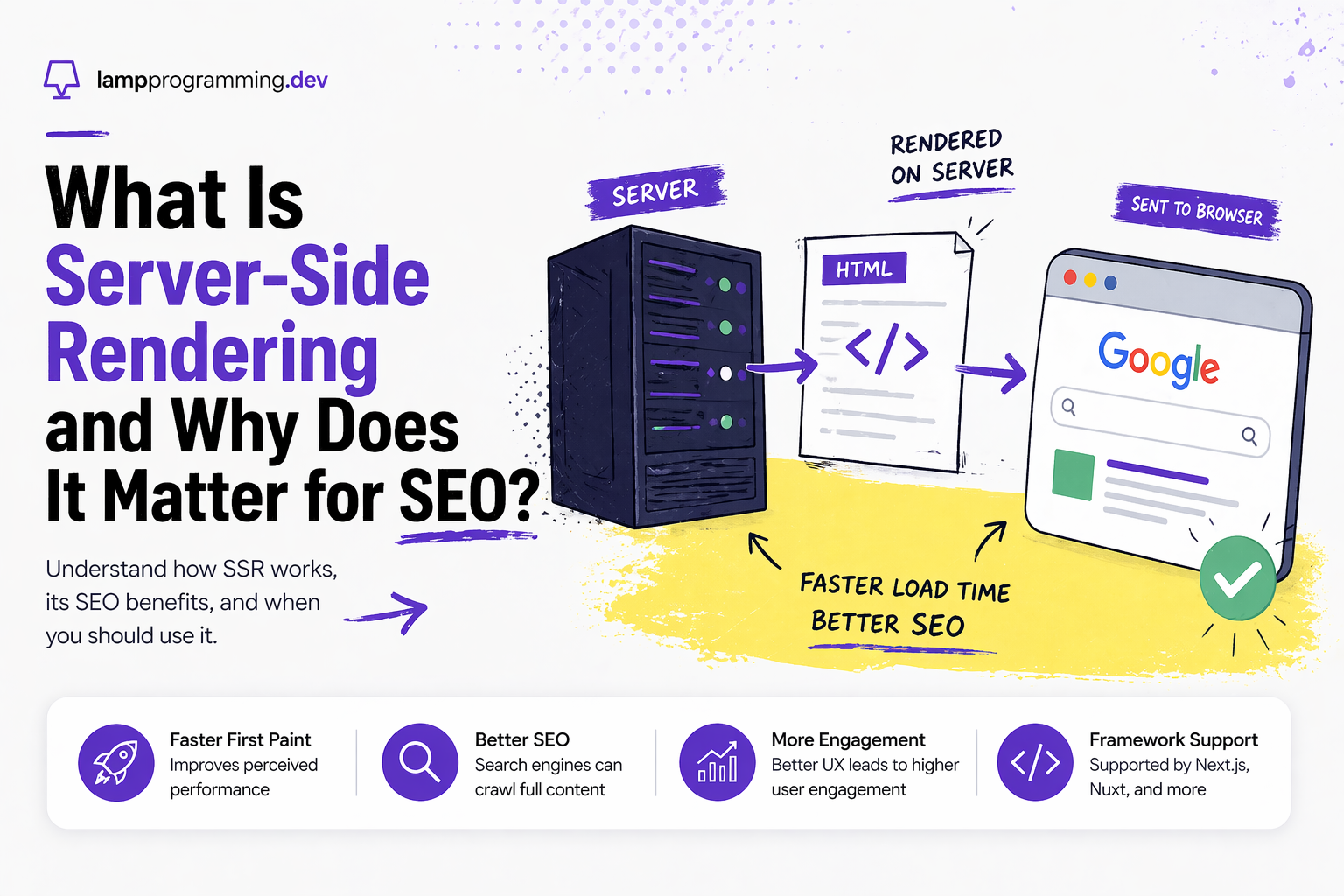
In an SSR app, the server generates the full HTML before sending it to the browser. The user receives a complete page immediately. The browser can display it before any JavaScript executes.
Frameworks like Laravel with Inertia.js, Next.js, and Nuxt.js enable SSR for otherwise client-side applications.
Why SSR Matters for SEO
Google's crawler can execute JavaScript, but not perfectly and not always on the first crawl. Pages that require JavaScript to render their main content are indexed later — sometimes weeks after the page is published — and with lower confidence than pages that render full HTML immediately.
With SSR, Googlebot receives a complete HTML page on the first request. It reads the content, indexes the title, description, and body text, and ranks the page. There's no rendering delay, no JavaScript dependency, and no risk of Googlebot seeing a blank page.
The Real-World SEO Impact
The difference between CSR and SSR for SEO shows up in:
- Indexing speed — SSR pages are indexed within days of publication; CSR pages can take weeks
- Rich snippets — structured data embedded in the HTML is read reliably by all search engines, not just Google
- Core Web Vitals — SSR improves Largest Contentful Paint (LCP), which is a direct ranking signal
- Social sharing — when someone shares a link on Slack, Twitter, or LinkedIn, the preview is generated by a bot that doesn't execute JavaScript. SSR pages show correct titles and OG images; CSR-only pages often show nothing.
SSR and Performance
SSR also reduces Time to First Byte (TTFB) and Largest Contentful Paint — two Core Web Vitals metrics that Google uses as ranking signals. A page that delivers fully rendered HTML in 200ms will consistently outperform a page that delivers an empty shell and then waits for JavaScript to hydrate the content.
When SSR Is Most Important
- Ecommerce product pages — product titles, prices, and descriptions must be indexable immediately
- Blog and content pages — article text must be readable by crawlers without JavaScript execution
- Location-specific landing pages — local SEO depends on crawlers reading geographically relevant content
- Any page you're investing in SEO for — if you want a page to rank, make sure it renders on the server
What We Use
Our sites are built on Laravel + Inertia.js + Vue.js with SSR enabled. Every page renders full HTML on the server before delivery. Googlebot, Bingbot, and all social media crawlers receive complete, structured content on every request. This architecture is one of the main reasons our clients' sites rank well and rank quickly after launch.
Ready to Grow Your Business Online?
LAMP Programming is a web development agency based in Santa Barbara, CA. We build fast, modern websites and ecommerce stores that generate real leads.
Frequently Asked Questions
- Server-side rendering (SSR) generates the full HTML page on the server before sending it to the browser. This means Google can index the content immediately without waiting for JavaScript to execute — leading to faster indexing and more reliable rankings.
- Google can execute JavaScript, but not always on the first crawl. Client-side rendered pages are often indexed weeks later than SSR pages and with lower confidence. SSR eliminates this risk entirely.
- SSR improves Largest Contentful Paint (LCP) — a direct Google ranking signal — because the browser receives rendered HTML immediately instead of waiting for JavaScript to build the page. It also improves Time to First Byte (TTFB).
- Next.js (React), Nuxt.js (Vue.js), and Laravel with Inertia.js all support SSR. LAMP Programming uses Laravel + Inertia.js + Vue.js with SSR enabled on all client projects.
- Yes. When someone shares a link on Slack, Twitter, or LinkedIn, the preview is generated by a bot that doesn't execute JavaScript. SSR pages show correct titles and OG images; client-side-only pages often display nothing.