Inertia.js is a library that connects server-side frameworks like Laravel with frontend frameworks like Vue or React, without building a separate API. It lets developers write classic server-driven applications that behave like single-page apps — fast navigation, no full page reloads, shared state — while keeping all routing and business logic on the server. LampProgramming uses Inertia.js with Laravel and Vue on every project we build.
How Inertia.js Works
A normal Laravel route or controller method still handles the request. Instead of returning a Blade view or a JSON payload, it returns an Inertia response that points to a Vue “page component” and passes whatever data that page needs as props — the same way you'd pass props to any Vue component. On the first request, Inertia renders that page to full HTML, just like a normal server-rendered app.
After that first load, Inertia's client-side router takes over. When a user clicks a link or submits a form, Inertia intercepts it, makes an XHR request to the same Laravel route, and swaps in the new page component with its props — no full page reload, no flash of a blank screen. The URL, browser history, and scroll position all update correctly, so it feels exactly like a single-page app. The difference is that there's no separate client-side router to configure and no API to design: the Laravel routes you already have are the only routing layer that exists.
Inertia.js vs Traditional SPA (React/Vue standalone)
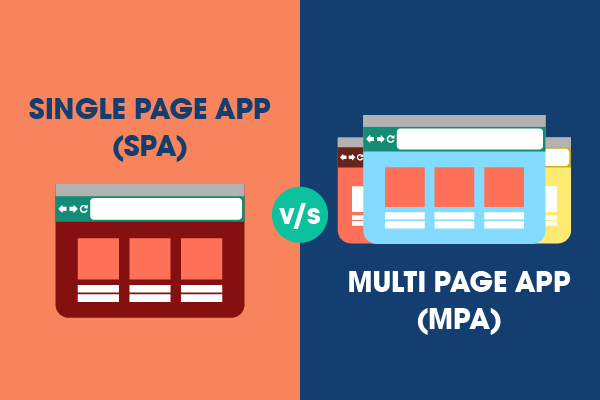
A traditional single-page app built with standalone Vue or React needs its own client-side router (Vue Router or React Router), its own state management layer, and a REST or GraphQL API to talk to. Validation rules, authentication logic, and business rules often end up duplicated — once on the backend to actually enforce them, and again on the frontend so the UI can respond without a round trip.
Inertia.js removes that duplication. Routing, validation, authorization, and business logic live once, in Laravel. The frontend framework's only job is to render whatever props the server hands it. You still get client-side navigation and a fluid, app-like feel — you just don't maintain two parallel systems to get it.
Inertia.js vs API-Driven Architecture
A fully decoupled, API-driven architecture — a separate REST or GraphQL backend consumed by an independent frontend — makes sense when you genuinely need multiple clients: a mobile app, a public API for partners, or several independent frontends sharing the same data. That flexibility comes at a cost: API resource classes, versioning, token-based authentication, CORS configuration, rate limiting, and (usually) API documentation to maintain alongside the actual application.
When the browser is your only client, most of that infrastructure is overhead you don't need. Inertia.js lets Laravel controllers pass data straight to page components without a serialization layer in between. If a public API becomes necessary later — for a mobile app or a third-party integration — you build one deliberately, alongside your Inertia app, rather than being forced into API-first architecture just to render your own frontend.
Why We Use Inertia.js with Laravel and Vue
Our default stack for client projects is Laravel development on the backend, Vue.js development on the frontend, and Inertia.js gluing the two together — with server-side rendering enabled by default rather than treated as an afterthought.
In practice that combination gives us a single codebase instead of a backend repo and a frontend repo drifting out of sync, no separate API to design, secure, and version, and full HTML delivered on the first request so pages are fast and fully indexable by Google from day one. It also means less context-switching for the team: business logic, validation, and routing all live in Laravel, and Vue components stay focused on presentation. For most business applications — client portals, internal tools, marketing sites with dynamic sections — that trade-off consistently produces a faster build and a more maintainable codebase than a hand-rolled API plus SPA.
If you're evaluating Inertia.js for an upcoming project, or you have a Laravel application that could benefit from a faster, more app-like frontend, contact us and we'll walk through whether it's the right fit.
Frequently Asked Questions
- Inertia.js is a library that allows developers to build server-driven single-page applications without a separate API. It connects backend frameworks like Laravel with frontend frameworks like Vue or React, handling routing on the server while delivering a fast, SPA-like experience in the browser.
- Inertia.js is used to build modern web applications with Laravel (or Rails/Django) on the backend and Vue or React on the frontend. It eliminates the need for a REST or GraphQL API by passing data directly from controllers to page components as props.
- For monolithic applications where the frontend and backend are in the same codebase, Inertia.js is often simpler and faster to build with than a separate REST API. It reduces boilerplate, eliminates API versioning, and keeps business logic server-side. For mobile apps or third-party integrations, a REST API is still needed alongside it.
- Yes. Inertia.js has official adapters for Vue 3, React 18, and Svelte. The most common combination is Laravel + Inertia.js + Vue 3, which is the stack LampProgramming uses for client projects.
- Yes, when used with server-side rendering (SSR). Laravel with Inertia.js and SSR enabled renders pages on the server before sending them to the browser, making all content fully crawlable by Google and other search engines — unlike client-side-only SPAs which can have SEO issues.