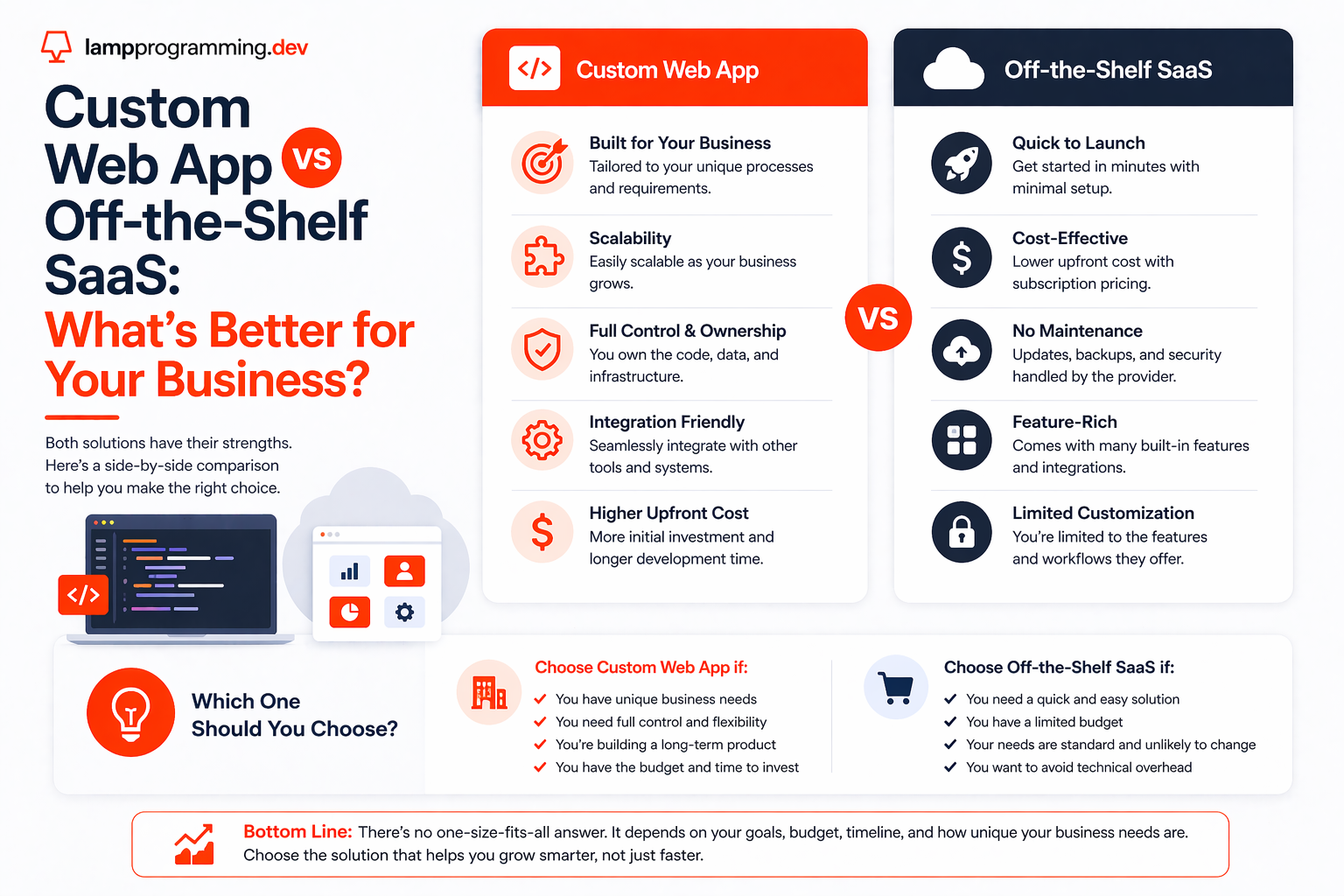
When a B2B business needs software, the core question is whether to build a custom web application or subscribe to an existing SaaS platform. Custom web app development gives you full control over features, data, and workflows — built exactly for your business logic. SaaS platforms offer faster setup and lower upfront cost but limit flexibility and lock you into someone else's roadmap. The right choice depends on your workflow complexity, budget, team size, and how long you plan to use the system.
What Is a Custom Web App?
A custom web app is software built specifically for your business — no shared codebase, no generic feature set designed to fit thousands of unrelated companies. Every workflow, user role, and integration is built around how your team actually operates. We build custom web apps on Laravel development as the backend foundation, which gives us the flexibility to model complex B2B workflows — multi-step approvals, tiered permissions, custom reporting — without fighting a framework designed for someone else's use case.
You own the codebase outright. There's no per-seat licensing, no vendor deciding which features move behind a higher pricing tier, and no risk of a tool you depend on being discontinued or acquired out from under you.
What Is a SaaS Platform?
SaaS (Software as a Service) is a pre-built product you subscribe to — a CRM, a project management tool, a booking system — usually priced per user, per month. You sign up, configure settings, and you're using it within minutes. Thousands of other companies use the exact same platform, which is precisely why it's fast to adopt: the vendor has already solved a version of your problem.
The trade-off is that you're renting someone else's roadmap. Features you rely on can move behind a higher-priced tier, get deprecated, or simply never ship because they don't fit the vendor's broader customer base. If you're building your own product to sell rather than an internal tool, that's a different conversation — SaaS development for your own multi-tenant platform is a custom build in its own right, not a subscription decision.
Custom Web App vs SaaS: Key Differences
The two approaches trade off in predictable ways once you lay them side by side:
| Factor | Custom Web App | SaaS Platform |
|---|---|---|
| Upfront cost | Higher — you're paying for development | Lower — subscribe and go |
| Ongoing cost | One-time build plus maintenance, no per-seat fees | Recurring subscription, often scales with team size |
| Flexibility | Built exactly around your workflows | Limited to the vendor's feature set |
| Data ownership | You own the code and the data outright | Vendor hosts and controls your data |
| Time to launch | Weeks to months, depending on scope | Minutes to days |
| Integrations | Built to connect directly with your existing systems | Limited to what the vendor's API supports |
| Long-term scalability | Scales with your business, no licensing ceiling | Can hit feature or pricing ceilings as you grow |
When to Choose Custom Web App Development
Custom development earns its higher upfront cost when one or more of these apply:
- Your workflow is complex or genuinely different from a standard process — multi-location scheduling, tiered approval chains, industry-specific compliance rules.
- You're paying for five or more SaaS tools that don't talk to each other, and stitching them together with spreadsheets and manual work.
- The software is core to your competitive advantage — it is the business, not a support tool around it.
- You plan to run the system for years, so the upfront cost amortises into a lower total cost of ownership than an ever-growing subscription.
- You need to own your data outright — for compliance, security, or simply not wanting a vendor holding your business hostage to a pricing change.
When to Choose SaaS
SaaS is the right call when speed and simplicity matter more than a perfect fit:
- Your process is standard — a CRM, email marketing platform, or scheduling tool solves it out of the box.
- You need to launch immediately and validate an idea before investing in a custom build.
- Budget is limited and a monthly subscription is easier to justify than an upfront development cost.
- You don't yet have — or want — an ongoing technical relationship to maintain custom software.
Custom Web App Development for B2B: What to Expect
A B2B custom web app project typically starts with mapping your current tools, spreadsheets, and manual workarounds, then scoping which parts of that process actually need custom logic versus what a standard integration can handle. From there it moves through a technical specification, iterative development with regular milestone demos, and a handover with documentation your team can build on.
Costs vary widely with scope: a focused internal tool with a handful of user roles can start around $15,000, while a full B2B platform with multiple integrations, custom reporting, and complex permissioning runs $100,000 or more. Most of our B2B custom web development projects land somewhere between those extremes, delivered in phases so you get a usable system well before the full build is complete.
If you're weighing a custom build against another SaaS subscription, contact us for a free assessment — we'll give you a straight answer, even if that answer is "stick with SaaS for now."
Frequently Asked Questions
- A custom web app is built specifically for your business needs, giving full control over features, data, and integrations. SaaS (Software as a Service) is a pre-built platform you subscribe to — faster to deploy but limited to the vendor's feature set and roadmap.
- For B2B businesses with complex or unique workflows, custom web app development is often better long-term. It eliminates per-seat licensing costs, integrates directly with existing systems, and can be built exactly around your processes. SaaS is better for standard workflows with tight timelines and budgets.
- Custom B2B web app development typically ranges from $15,000 for simple internal tools to $100,000+ for complex platforms with multiple integrations, user roles, and custom reporting. Costs depend on scope, timeline, and team location.
- Choose SaaS when your needs match a standard workflow, your budget is limited, you need to launch quickly, or the problem is well-solved by existing tools. CRM, email marketing, and HR management are common areas where SaaS outperforms custom builds.
- Yes. Many businesses build custom web apps to consolidate multiple SaaS subscriptions into one integrated platform — reducing costs, eliminating data silos, and gaining full ownership of their business logic and data.