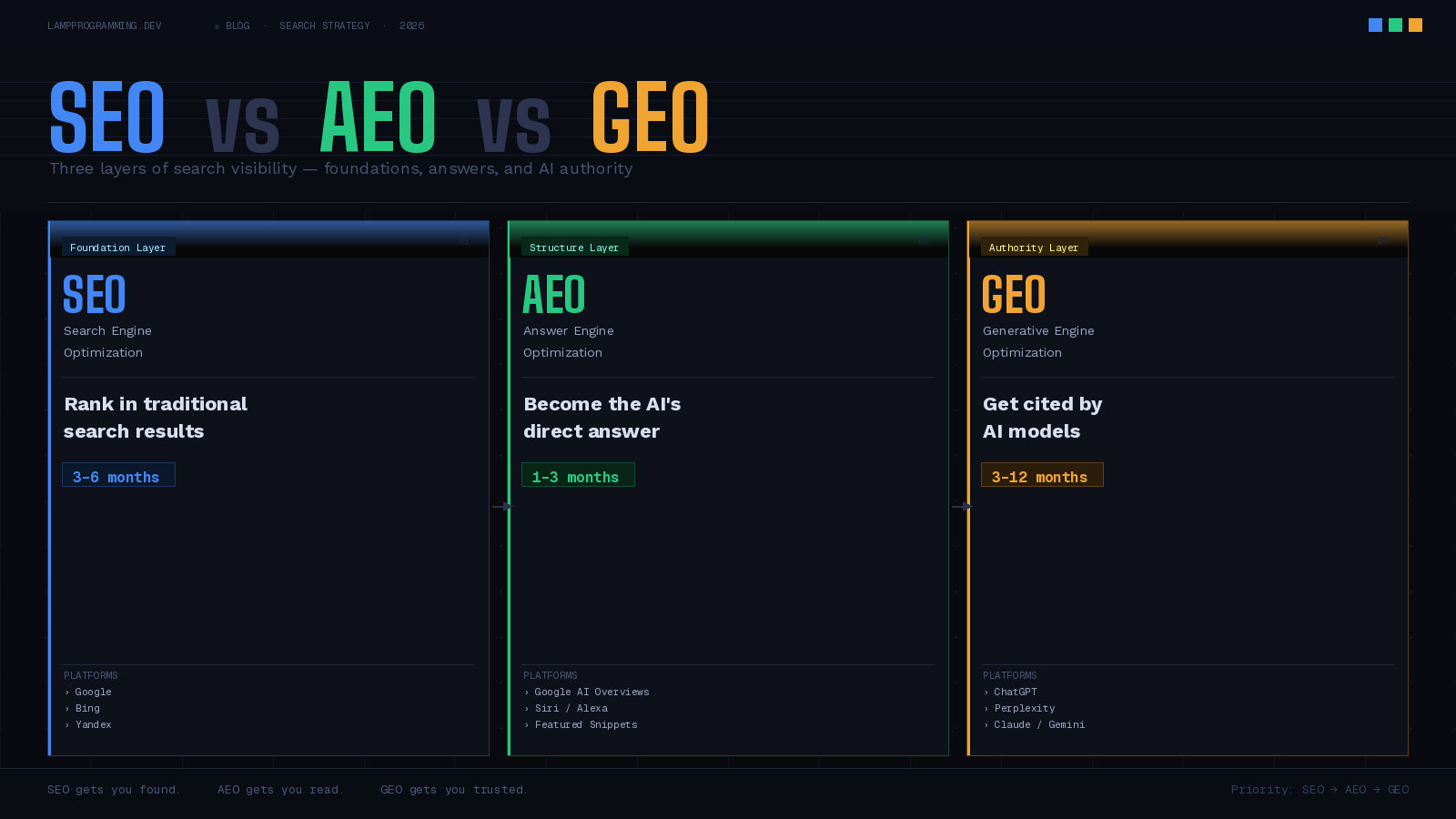
SEO (Search Engine Optimisation) gets your pages ranked on Google. AEO (Answer Engine Optimisation) gets your content selected as direct answers in Google's AI Overviews and featured snippets. GEO (Generative Engine Optimisation) gets your business cited by AI tools like ChatGPT, Perplexity, and Claude when users ask questions in those platforms. All three matter in 2026 — but they require different content strategies, different formats, and different success metrics.
TL;DR: SEO (Search Engine Optimization) helps your website rank in traditional search results as a blue link. AEO (Answer Engine Optimization) structures your content so AI systems — like Google AI Overviews, Siri, and Alexa — display it as a direct answer without a click. GEO (Generative Engine Optimization) builds brand authority so that AI tools like ChatGPT, Perplexity, and Claude cite your brand by name in their responses. Priority order: SEO → AEO → GEO.
Not long ago, “being visible in search” meant one thing: getting to page one of Google. Today, users get answers directly from AI — without clicking a single link. And AI chat tools recommend brands by name, without a search result in sight.
If you’re building or marketing a website in 2026, you need to understand three distinct strategies: SEO, AEO, and GEO. They are not interchangeable, they don’t replace each other, and they each require different implementation tactics.
This guide explains exactly what each one is, how they differ, and which one you should prioritize right now.
What Is SEO (Search Engine Optimisation)?
SEO is the practice of improving a website’s visibility in traditional organic search results — the ranked list of blue links returned when someone types a query into Google, Bing, or Yandex. SEO has existed since search engines themselves, and at its core it is about convincing algorithms that your page is the most relevant and trustworthy result for a given query.
The Three Pillars of SEO
- Content — Keyword research, on-page optimization, heading structure, internal linking, and article depth.
- Authority — Backlinks from external websites, domain rating, and brand mentions across the web.
- Technical — Page speed, Core Web Vitals, mobile-friendliness, HTTPS, crawlability, and clean URL structure.
What Does SEO Give You?
When a user searches “best web development agency in Spain,” your site appears in the list of links on page one. The user chooses to click — or not. SEO is about presence, not guaranteed visibility. You are one of several options competing for the click.
⏱ Typical timeline to see results: 3–6 months
What Is AEO (Answer Engine Optimisation)?
AEO is the optimization of content so that AI-powered search systems can extract and display it as a direct answer — without the user needing to click through to the website. AEO is the evolution of SEO for a world where AI does the reading for users.
Google’s AI Overviews, Apple’s Siri, Amazon Alexa, and Yandex’s Alice don’t return links — they return answers. AEO is how you become that answer.
Where AEO Answers Appear
- Google AI Overviews (the AI-generated summary at the top of search results)
- Voice assistants: Siri, Google Assistant, Alexa, Cortana
- “People Also Ask” boxes in Google
- Featured Snippets (position zero)
- Bing Copilot answer blocks
How to Make Content AEO-Ready
- Write a direct, concise answer in the first 2–3 sentences of every article.
- Add FAQ sections with clearly phrased questions and short answers.
- Implement structured data markup:
FAQPage,HowTo, andProductschema in JSON-LD. - Write headings as questions: “What is…?”, “How does…?”, “When should you use…?”
- Show author credentials and E-E-A-T signals — especially critical for health, legal, and finance topics.
- Use numbered lists for step-by-step instructional content.
💡 Key insight: AEO content doesn’t replace regular articles — it complements them. A blog post optimized for AEO starts with a 2-sentence answer, then expands into the full explanation. The AI reads the summary; the human who wants depth reads the rest.
⏱ Typical timeline to see results: 1–3 months
What Is GEO (Generative Engine Optimisation)?
GEO is the practice of building brand authority so that AI language models cite, recommend, or reference your brand inside their generated responses — without a user searching for you directly. It operates at a completely different level from SEO and AEO.
When a user asks ChatGPT “What is the best web development agency in Spain?” — GEO determines whether your name comes up in the answer.
How AI Decides Who to Cite
- Frequency of mentions on authoritative external websites
- Backlinks and references from high-trust domains (universities, press, industry publications)
- Brand mentions in community forums (Reddit, Quora, Stack Overflow)
- Original data, studies, or research that other sites reference
- Named expert authorship with verifiable credentials
- Presence in podcasts, video interviews, and industry roundups
GEO vs AEO: The Key Difference
AEO is about structuring your content for AI to extract answers from. GEO is about being known enough that AI considers you a trustworthy source to begin with. AEO is a technical implementation. GEO is reputation management at the AI layer.
⏱ Typical timeline to see results: 3–12 months (long-term strategy)
SEO vs AEO vs GEO: Key Differences
| Parameter | SEO | AEO | GEO |
|---|---|---|---|
| Full Name | Search Engine Optimization | Answer Engine Optimization | Generative Engine Optimization |
| Primary Goal | Rank in blue-link results | Become the direct answer | Get cited by AI models |
| Target Platform | Google, Bing, Yandex | AI Overviews, Siri, Alexa, PAA | ChatGPT, Perplexity, Claude, Gemini |
| Content Format | Keyword-rich articles | FAQ, Q&A, definitions, how-to | Authoritative long-form, cited research |
| User Action | Clicks your link | Gets the answer (may not click) | Hears your brand name from AI |
| Typical Timeline | 3–6 months | 1–3 months | 3–12 months |
Does AEO Replace SEO? No — Here’s Why
This is the most common misconception. The assumption is that if AI gives direct answers anyway, traditional SEO becomes irrelevant. That is wrong — and implementing AEO without SEO as a foundation is a waste of time.
AI systems still rely on Google’s authority and indexing signals to decide whose content to trust. If your site has weak SEO fundamentals — low domain authority, poor content, missing backlinks — AI engines will not surface your content as an answer, regardless of how many FAQ schemas you add.
🏗️ Think of it as a building: SEO is the foundation and structural walls. AEO is the interior layout that makes navigation easy for AI. GEO is the building’s reputation in the neighbourhood. You cannot build the upper floors without the foundation.
Which Should Your Business Focus On?
The right priority depends entirely on where your site stands today:
- New website with no traffic → SEO first, everything else later.
- Has traffic but 0 keyword rankings → Fix SEO content, then add AEO schema.
- Ranking well but not in AI Overviews → Implement AEO: FAQ schema + answer-first paragraphs.
- Want ChatGPT to recommend you → GEO: PR, guest publications, expert citations.
- Long-term brand strategy → All three in parallel with a structured roadmap.
How LampProgramming Optimises for All Three
At LampProgramming, we treat SEO, AEO, and GEO as layers of the same visibility strategy rather than three separate projects. Every site we build starts with solid SEO fundamentals — clean information architecture, fast Laravel development, and content that actually answers the query it is targeting.
From there, we layer in AEO optimisation services: FAQ sections written in clear question-and-answer format, structured data markup so AI systems can parse your content accurately, and answer-first paragraphs that give both users and AI a direct response before the detail. GEO is the long game — earning the mentions, citations, and authoritative signals that get a brand referenced by name inside ChatGPT or Perplexity responses, rather than just ranked in a list.
If your site ranks well but is not showing up in AI Overviews or getting cited by AI tools, contact us and we will audit where the gap actually is.
Final Thoughts
SEO gets you found. AEO gets you read. GEO gets you trusted.
In 2026, winning in search means operating at all three layers — in the right order.
Need help implementing SEO, AEO, or GEO for your website? Talk to the LAMP Programming team — we build technically excellent websites with search visibility built in from day one.
Frequently Asked Questions
- SEO (Search Engine Optimisation) focuses on ranking in traditional search results. AEO (Answer Engine Optimisation) focuses on getting content selected as direct answers in Google AI Overviews and featured snippets. GEO (Generative Engine Optimisation) focuses on getting cited by AI tools like ChatGPT, Perplexity, and Claude when users ask questions directly.
- Answer Engine Optimisation (AEO) is the practice of structuring content so search engines and AI systems select it as a direct answer to user questions. AEO techniques include writing clear Q&A sections, adding FAQ schema (JSON-LD), using concise factual language, and structuring content with short declarative sentences that AI systems can extract.
- Generative Engine Optimisation (GEO) is the practice of making your business and content more likely to be cited by AI tools like ChatGPT, Perplexity, Google Gemini, and Claude. GEO involves building authoritative content, earning mentions on high-authority sites, using structured data, and ensuring your key facts are stated clearly enough for AI models to reference them accurately.
- No. AEO complements SEO rather than replacing it. Traditional search results still drive significant traffic, especially for commercial and navigational queries. AEO targets the growing share of queries answered directly by AI Overviews and voice search. Businesses should optimise for both simultaneously.
- To optimise for AI search tools (GEO), focus on: building factual, well-structured content on authoritative domains; earning mentions and backlinks from trusted sources; using clear entity definitions so AI models understand who you are; adding structured data markup; and ensuring your brand and services are described consistently across the web.