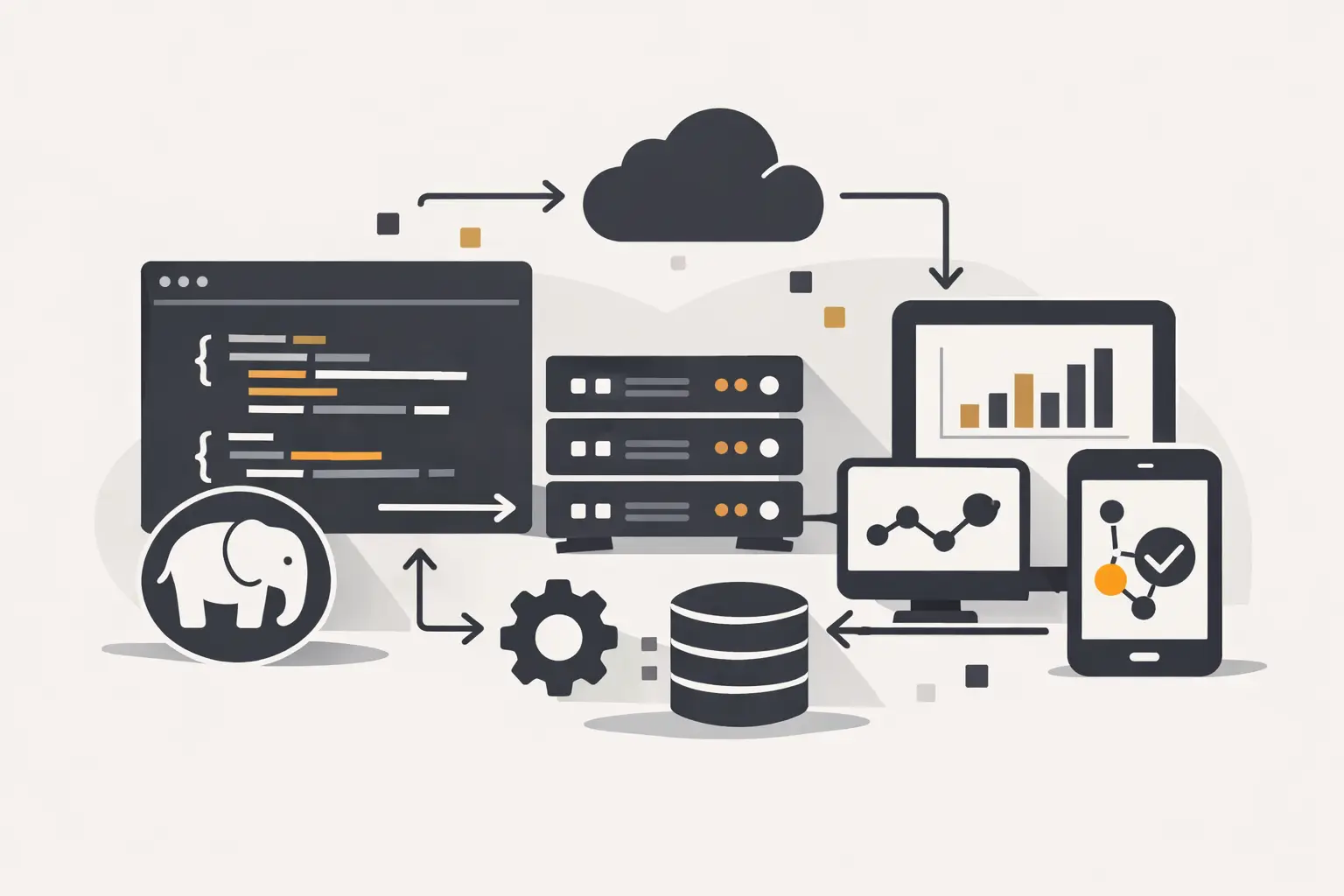
A customer places an order, an operations manager updates inventory, and a marketing platform sends a follow-up message. If the backend handles those events poorly, the front end cannot compensate. The purpose of this PHP backend development guide is to show how businesses can approach PHP development as long-term application infrastructure, not a collection of pages and plugins.
PHP remains a practical choice for custom portals, ecommerce integrations, SaaS products, internal tools, and API-driven applications. It has a mature ecosystem, broad hosting support, and strong frameworks for teams that need to ship useful software without creating an expensive maintenance problem. The language is not the strategy, though. Architecture, data modeling, security, testing, and deployment discipline determine whether a PHP application remains dependable after its first release.
Start With the Operational Problem
A backend should reflect how the business actually works. Before selecting packages or defining database tables, document the important workflows: who performs an action, what data changes, what must happen next, and where failures need to be visible.
For an ecommerce brand, that may mean syncing products from Shopify or BigCommerce, validating order data, sending fulfillment updates to a warehouse, and recording support activity in a CRM. For a service company, it may mean managing estimates, appointments, documents, payments, and GoHighLevel automation. These are not generic CRUD screens. They are operational processes with rules, exceptions, and ownership.
This discovery work prevents a common mistake: building a technically polished system that forces staff to change a process that was already working. Some processes should be improved, of course, but that decision should be deliberate. A good backend reduces manual work, limits duplicate data entry, and gives people reliable information when they need it.
Use Laravel for Structure, Not Just Speed
For most custom PHP projects, Laravel is a sensible foundation. It provides routing, authentication, validation, database migrations, queues, caching, scheduled tasks, and a consistent way to organize code. Those capabilities shorten development time, but their larger value is consistency. A new developer should be able to understand where business logic belongs and how an application behaves without reverse-engineering every feature.
The fastest path is not always the cheapest path. Laravel's conventions can feel restrictive when a team wants to put logic directly in controllers or write one-off queries everywhere. That approach may work for a small prototype. It becomes costly when the application adds multiple user roles, recurring jobs, integrations, reporting requirements, and support needs.
Keep controllers thin. A controller should receive a request, authorize it, validate input, call an application service or action, and return a response. Put business rules in focused classes that can be tested independently. For example, an OrderSyncService can coordinate data from an ecommerce platform, while separate classes handle tax mapping, inventory updates, and notification rules.
Avoid creating layers simply because a pattern is fashionable. A two-person internal tool does not need enterprise-level abstraction from day one. The right amount of structure depends on expected complexity, the number of integrations, and how long the software needs to be maintained.
Design the Database Before Building Screens
Most business applications succeed or fail on the quality of their data. PostgreSQL is a strong default for PHP applications because it handles relational data, transactions, constraints, indexing, and advanced queries well. More importantly, it encourages clear modeling of the relationships that run the business.
Start by identifying the source of truth for each important record. If Shopify owns product pricing, do not allow an internal admin panel to silently overwrite it. If a custom application owns appointment availability, make that clear to the calendar integration. Confusion over data ownership creates duplicate records, sync loops, and support tickets that are difficult to diagnose.
Use database constraints where they add protection. Unique indexes can stop duplicate external IDs. Foreign keys can prevent orphaned records. Transactions can ensure that a payment record and an invoice update either both succeed or both fail. Application-level validation is still necessary, but the database should not accept obviously invalid states.
Indexing deserves attention early, especially for dashboards and reporting. A query that works quickly with 500 rows may become a bottleneck with 500,000. Index columns used for joins, filtering, sorting, and foreign key lookups. Measure slow queries before adding indexes indiscriminately, since unnecessary indexes also slow writes and increase storage use.
Build APIs That Survive Real Integrations
APIs are often where custom PHP development creates the most value. They connect storefronts, payment providers, shipping systems, CRMs, accounting platforms, mobile apps, and internal dashboards. They also introduce failure modes that do not appear in a standalone website.
Treat external API calls as unreliable by default. A provider may rate-limit requests, send duplicate webhooks, return partial data, or become temporarily unavailable. Your application needs clear handling for each condition. Store external event IDs to make webhook processing idempotent, meaning the same event can be received twice without creating two orders or two refunds.
Move slow work out of the web request whenever possible. Laravel queues are useful for sending emails, processing imports, generating reports, syncing catalog changes, and calling third-party APIs. The customer or staff member receives a fast response, while the application processes longer work in the background.
Queued work requires visibility. Failed jobs should be logged with enough context to investigate the issue, and important failures should trigger alerts. Retrying a failed sync automatically can help, but unlimited retries can make a bad situation worse. Use reasonable retry limits and a process for reviewing jobs that require human attention.
Version public APIs when clients outside your team depend on them. You do not need a new version for every small change, but removing or changing a field without a transition plan can break a mobile app, partner integration, or agency-managed workflow.
Security Is Part of the Build, Not a Final Checklist
A PHP backend handles credentials, customer records, payment-related events, and business data. Security needs to be built into normal engineering work.
Use framework authentication and authorization features rather than custom session logic. Define permissions based on roles and policies, then enforce them on every action that reads or changes protected data. A user who can view an order should not automatically be able to issue a refund or export an entire customer list.
Validate every request at the server. Front-end validation improves usability, but it does not protect the application. Validate types, allowed values, file uploads, ownership, and relationships between fields. Use parameterized queries or the framework's query builder to prevent SQL injection, and escape output appropriately to reduce cross-site scripting risks.
Keep secrets out of source code. API keys, database credentials, and signing secrets belong in environment configuration managed by the deployment process. Rotate keys when a vendor relationship changes or a credential may have been exposed. For webhooks, verify signatures before processing the payload.
Backups are also a security and continuity concern. A backup that has never been restored is only an assumption. Define retention requirements, test restoration procedures, and decide how quickly the business needs to recover after a failure.
Test the Work That Would Hurt to Get Wrong
Testing is not about chasing an arbitrary coverage percentage. It is about protecting the actions that create financial, operational, or customer impact. Test authorization, pricing rules, payment states, inventory adjustments, subscription changes, import logic, and integration edge cases.
Laravel supports unit, feature, and browser-level testing. Unit tests are useful for isolated business rules. Feature tests verify that routes, validation, permissions, database changes, and responses work together. For a typical custom application, feature tests often deliver more practical confidence because they cover the request lifecycle users depend on.
Automated tests should run before deployment. They will not catch every problem, especially visual issues or unclear workflows, but they make ordinary changes safer. Pair them with staging environments and a focused acceptance review for major releases.
Deploy for Recovery, Not Just Release Day
Production deployment is an operational process. Whether the application runs on AWS, DigitalOcean, or Forge-managed servers, it needs separate environments, controlled configuration, database migration procedures, logs, monitoring, and a rollback plan.
Database changes require extra care. Adding a nullable column is usually low risk. Renaming or removing a heavily used column may require a staged migration so old and new code can operate together temporarily. For high-traffic systems, deploy changes in small, reversible steps rather than treating each release as a single all-or-nothing event.
Monitor the signals that affect users: server errors, queue failures, slow requests, scheduled task failures, storage capacity, and third-party API issues. A client should not be the first person to report that orders stopped syncing overnight.
PHP Backend Development Guide: Maintain What You Build
The ongoing cost of software is shaped by decisions made before launch. Clear code, current dependencies, documented integrations, automated deployments, and tested recovery procedures reduce the amount of time spent reacting to avoidable issues.
Plan for maintenance from the start. PHP versions and packages need updates. External APIs change. Staff workflows evolve. A maintenance agreement should cover monitoring, security patches, dependency updates, backup checks, and a clear process for prioritizing improvements. It should also distinguish routine upkeep from new feature development, so expectations and budgets stay clear.
The best backend is not the one with the most services or the newest stack. It is the one that accurately supports the business, gives the team confidence in its data, and can be changed without turning every request into a risky project. Build for that standard, and PHP remains a practical foundation for software that has to keep working long after launch day.
Frequently Asked Questions
- With the operational workflow, not the database tables or packages. Document who performs each action, what data changes, what happens next, and where failures need to be visible — this prevents building a technically polished system that forces staff to abandon a process that was already working.
- Laravel provides routing, authentication, validation, migrations, queues, and a consistent way to organize code. Its larger value is consistency — a new developer can understand where business logic belongs without reverse-engineering every feature, which matters as an application adds user roles, integrations, and reporting needs.
- A controller should receive a request, authorize it, validate input, call a service class, and return a response — business rules belong in focused, independently testable classes (like an OrderSyncService), not directly inside the controller.
- Without clear ownership of each record type, multiple systems editing the same data creates duplicate records and sync loops that are hard to diagnose. If Shopify owns product pricing, an internal admin panel shouldn't be able to silently overwrite it.
- It means designing for rate limits, duplicate webhooks, partial data, and temporary outages from the start. Storing external event IDs makes webhook processing idempotent, so the same event received twice doesn't create duplicate orders or refunds.
- Slow tasks like sending emails, processing imports, or calling third-party APIs shouldn't block a customer's response. Laravel queues let the user get a fast response while longer work happens in the background — but failed queued jobs need logging and alerting, not silent retries.
- Framework-based authentication and role/policy-based authorization enforced on every protected action, server-side validation of all requests (not just frontend validation), parameterized queries to prevent SQL injection, secrets kept out of source code, and webhook signature verification before processing payloads.
- Focus testing on actions that would hurt to get wrong — authorization, pricing rules, payment states, inventory adjustments, and integration edge cases. Feature tests often deliver the most practical confidence because they verify routes, validation, permissions, and database changes work together through the full request lifecycle.