When you're ready to sell online, one of the first decisions you'll face is whether to use Shopify or build a custom ecommerce platform. Both work. The right answer depends on your business model, your growth trajectory, and how much control you need.
What Shopify Is
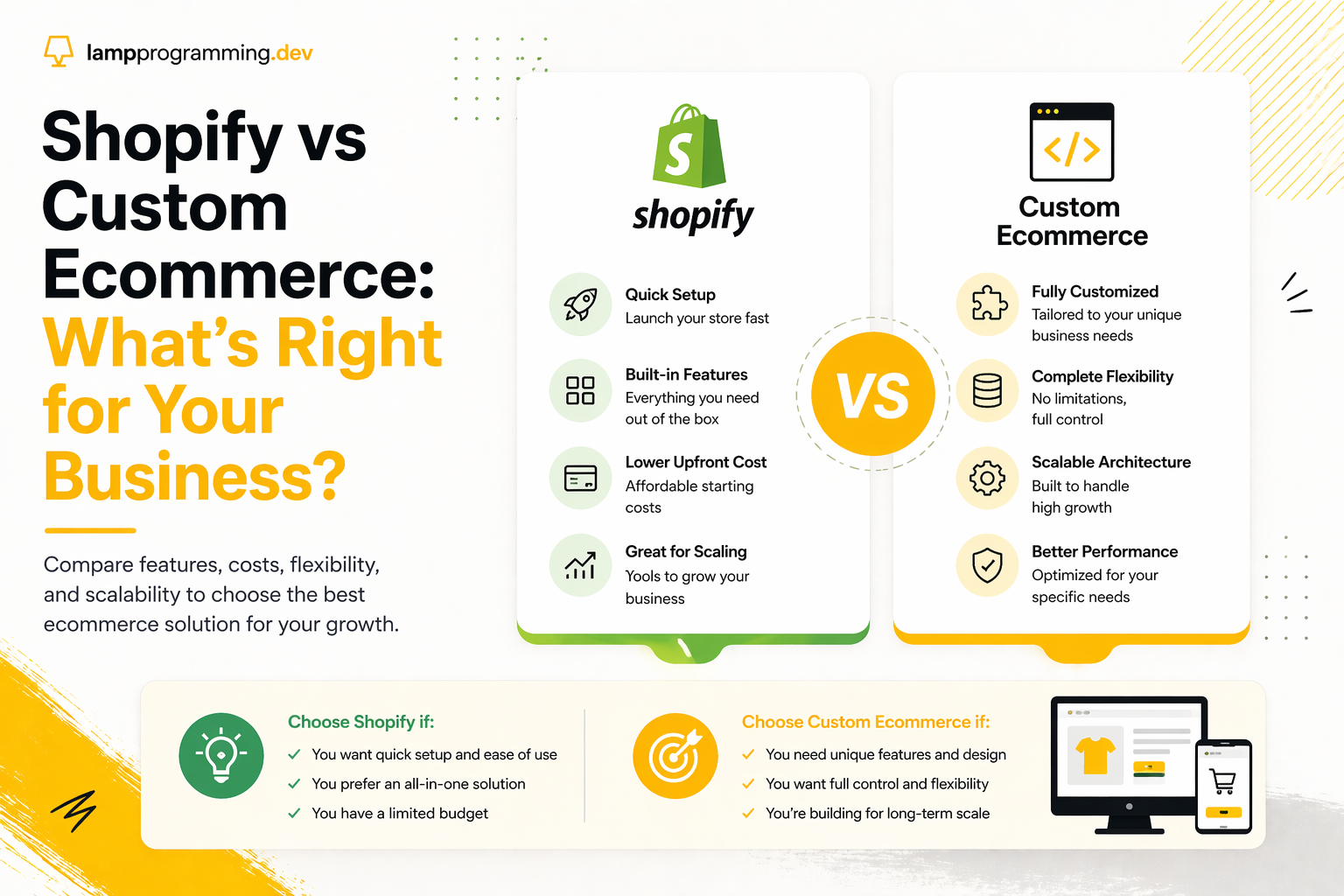
Shopify is a hosted ecommerce SaaS platform. You pay a monthly subscription ($29–$299/month, plus transaction fees), and in return you get hosting, a checkout flow, payment processing, inventory management, and a large library of themes and apps.
For many businesses, Shopify is the fastest path to revenue. You can configure a store, add products, and accept payments in a day.
What Custom Ecommerce Is
A custom ecommerce platform is built from scratch — typically on a framework like Laravel — with a frontend built in Vue.js, React, or another modern stack. Nothing is borrowed from a SaaS platform. Every feature is engineered for your specific business.
Where Shopify Wins
Speed to Market
Shopify gets you selling in days, not months. If you're launching a new product or testing a market, that speed has real business value.
Built-In Operations
Shipping labels, tax calculation, fraud analysis, abandoned cart emails — Shopify handles these out of the box. A custom build needs to either integrate third-party services or build these features from scratch.
App Ecosystem
The Shopify App Store has thousands of integrations — loyalty programs, subscription billing, product review widgets, and more. Many of these would take weeks to build custom.
Where Custom Ecommerce Wins
No Platform Fees
Shopify takes 0.5%–2% of every transaction if you don't use Shopify Payments. At $500,000/year in revenue, that's $2,500–$10,000 in fees — every year. A custom platform eliminates this entirely.
Complex Business Logic
If your pricing model involves custom quotes, B2B net terms, subscription tiers, or complex inventory rules, Shopify's checkout becomes a limitation. Custom platforms can encode any business logic you need.
Performance Control
Shopify runs on shared infrastructure. You don't control caching, CDN configuration, or server-side rendering behavior. A custom platform can be tuned for 90+ PageSpeed scores and sub-second load times at scale.
Full Code Ownership
With Shopify, your store exists inside their platform. If Shopify raises prices, changes their API, or shuts down an app you depend on, you're affected. With a custom platform, you own everything.
The Decision Framework
Start with Shopify if:
- You're launching and need to validate product-market fit fast
- Your catalogue is standard — products with variants, standard pricing, normal checkout
- You don't have complex B2B or wholesale requirements
- You want to run the store yourself without a developer on retainer
Choose custom if:
- You're doing over $1M/year in revenue and platform fees are adding up
- Your product or pricing model doesn't fit a standard Shopify checkout
- You need tight integration with an ERP, WMS, or custom fulfillment system
- You want complete ownership of your data, platform, and roadmap
The Middle Ground: Headless Shopify
Some businesses run Shopify as a backend — handling payments, inventory, and fulfillment — while serving the frontend from a custom-built Next.js or Vue.js application. This gives you Shopify's operational reliability with full frontend control. It's the best of both worlds, and it's increasingly what high-growth DTC brands choose.
Ready to Grow Your Business Online?
LAMP Programming is a web development agency based in Santa Barbara, CA. We build fast, modern websites and ecommerce stores that generate real leads.
Frequently Asked Questions
- Shopify is usually better for small businesses starting out — it's faster to launch, easier to manage, and includes hosting and payments out of the box. Custom ecommerce makes more sense once you exceed $500k/year in revenue or need complex business logic.
- A custom ecommerce platform typically starts at $15,000 and scales to $100,000+ depending on catalogue size, integrations, and business logic complexity. Ongoing development and maintenance add to the total cost of ownership.
- Shopify charges 0.5%–2% per transaction if you don't use Shopify Payments. At $500,000/year in revenue that's $2,500–$10,000 annually — one of the key reasons high-volume stores move to custom platforms.
- Yes. Products, customers, and order history can be exported from Shopify and imported into a custom platform. The migration requires careful planning but is a common move for growing businesses.
- Headless Shopify uses Shopify as the backend for payments and inventory while serving the storefront from a custom-built application like Vue.js or Next.js. It gives you Shopify's operational reliability with full frontend control.