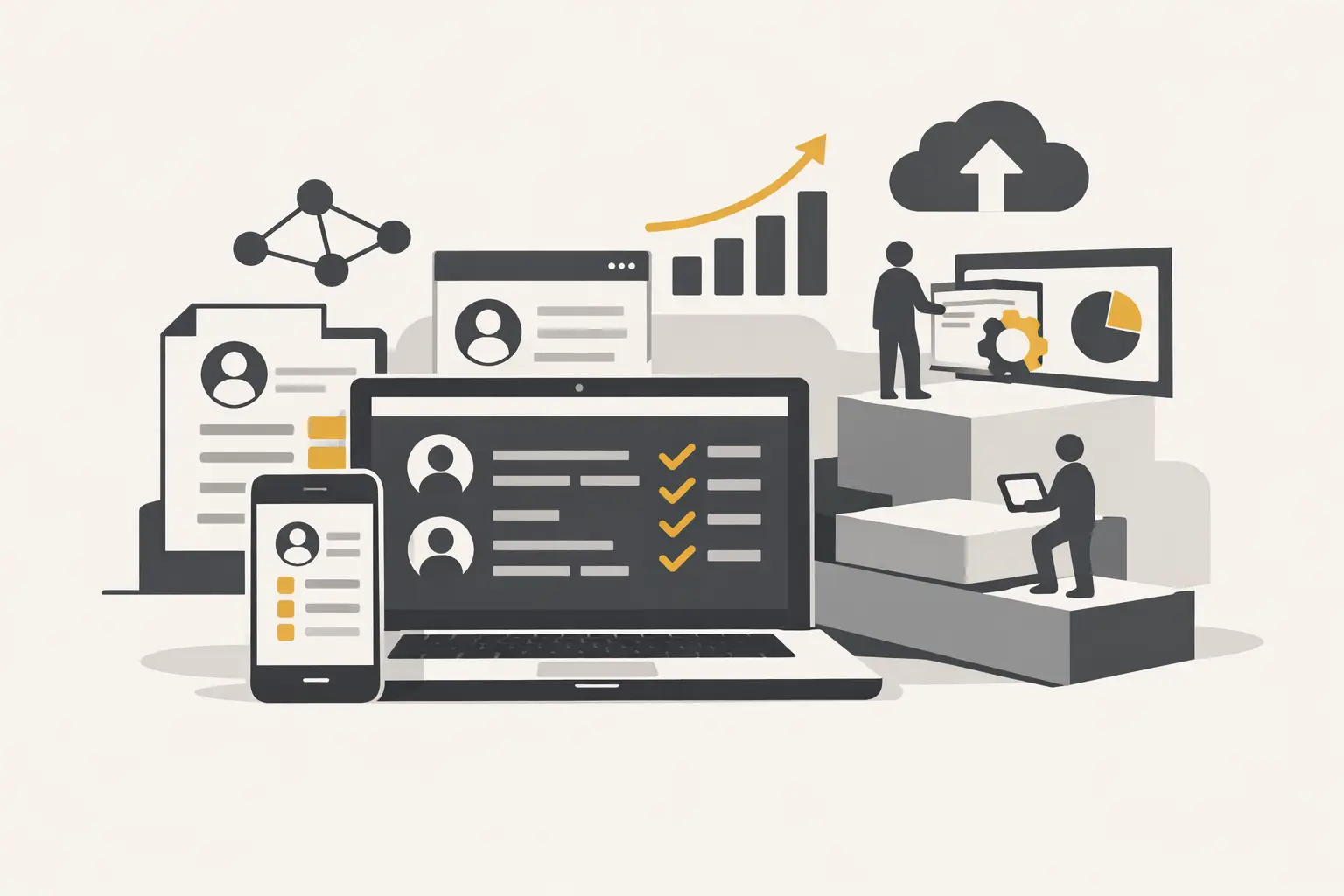
A client portal is not just a login page with a file upload button. Done well, it becomes the operating layer between your team and your customers: a secure place to share documents, manage approvals, track work, submit requests, and reduce the constant back-and-forth of email.
When teams ask how to build client portal software, the real question is usually bigger: what should clients be able to do without creating more operational complexity for staff? The answer depends on your workflow, your customer volume, and the systems you already use. A useful portal should remove friction on both sides, not simply move it behind a password.
Start With the Client Workflow, Not the Feature List
The most expensive portal mistake is building around a generic checklist. Teams often start with features such as messaging, dashboards, notifications, and document storage before defining the actual client journey. That produces a polished interface that customers rarely need and staff still have to work around.
Start by mapping the moments where a client currently waits, sends an email, calls for a status update, or submits the same information more than once. For a marketing agency, that may be campaign approvals, asset uploads, reporting, and invoice access. For a contractor, it may be change orders, project milestones, documents, and service requests. For an ecommerce brand working with wholesale accounts, it might include order history, account-specific pricing, returns, and inventory notices.
Ask three practical questions: What information do clients need on demand? What actions should they complete themselves? Which internal steps are currently repeated by your team?
The portal should solve those specific problems first. A smaller portal that handles three high-frequency tasks reliably will create more value than a broad platform full of unused modules.
Define Roles, Permissions, and Boundaries Early
Client portals almost always have more than two user types. In addition to clients and internal administrators, you may have account managers, project contributors, finance users, vendors, or client-side approvers. Each group should see only the data and actions required for its role.
This is where many low-code or template-based portals become difficult to maintain. A simple setup may work for one client account, then break down when an organization needs multiple contacts, multiple locations, separate billing access, or approval limits. Permission rules that were treated as an afterthought become expensive to retrofit.
Define access at the data level, not just the screen level. For example, a client user should only retrieve records associated with their organization. An internal project manager may access assigned accounts but not every customer record. Finance staff may see invoices without seeing private project discussions.
For higher-risk data, include controls such as multi-factor authentication, session expiration, audit logs, encrypted file storage, and clear retention rules. The right level of security depends on what the portal handles. A portal for marketing approvals has different requirements than one that stores financial, health, or legal records. Either way, security needs to be part of the architecture from the first sprint.
Choose a Build Approach That Fits the Business
There are three common routes: configure an existing platform, extend software you already use, or build a custom portal.
An existing portal product can be the right choice when your process is standard and speed matters more than differentiation. It may cover document sharing, ticketing, and basic client communication with minimal development. The trade-off is that you adapt your workflow to the platform, and customization can become limited or costly as requirements grow.
Extending an existing CRM, ecommerce system, or agency platform can work well when that system is already the source of truth. For example, a portal may surface data from Shopify, BigCommerce, GoHighLevel, WordPress, or a custom operations platform. This avoids duplicate data entry, but integrations must be planned carefully. A portal that displays stale order data, duplicate contacts, or inconsistent project status will quickly lose user trust.
A custom build makes sense when your workflow is a real competitive advantage, when you need precise integrations, or when off-the-shelf software forces too much manual work. It also gives you control over the user experience, ownership of your data model, and a clearer path for future features. The trade-off is that custom development requires disciplined discovery, design, testing, and ongoing maintenance.
For many small and mid-sized businesses, the best answer is not fully custom on day one. Build a focused custom layer around the workflows that matter most, while integrating with proven systems for payments, email, accounting, ecommerce, or customer relationship management.
How to Build Client Portal Software in the Right Order
A reliable build process starts with a short discovery phase. This should produce a workflow map, a list of user roles, a prioritized feature set, data sources, and measurable success criteria. “Make communication easier” is not a measurable requirement. “Reduce project-status emails by 40 percent” is.
Next, create wireframes for the critical paths. Focus on the actions clients perform most often: signing in, finding current work, approving an item, downloading a document, submitting a request, or paying an invoice. A portal dashboard should answer one question quickly: what needs my attention right now?
After the interface direction is clear, design the technical foundation. A maintainable portal typically needs a clear API layer, a normalized database structure, role-based authorization, background jobs for notifications and imports, and logging for important user actions. Laravel is a practical backend choice for this kind of work because it supports structured authentication, authorization policies, queues, APIs, and long-term code organization. Vue or React can provide responsive, task-focused interfaces, while PostgreSQL is well suited to relational client, project, transaction, and permission data.
The deployment plan matters too. Use separate development, staging, and production environments. Test changes in staging before clients see them. Automated backups, monitoring, error reporting, and a defined release process prevent a portal from becoming another fragile business system that only one person understands.
Integrate Systems Without Creating a Data Mess
Most portals do not operate alone. They need information from accounting software, CRMs, ecommerce platforms, payment processors, email tools, scheduling systems, or internal databases. Before connecting anything, decide which platform owns each type of data.
For example, your CRM may own contacts and account status, your accounting platform may own invoices and payments, and the portal may own service requests and approvals. If two systems can edit the same record without clear rules, mismatches are inevitable.
Use APIs and webhooks where possible, but do not assume real-time synchronization is always necessary. Real-time data is useful for order status, payment confirmation, and time-sensitive service updates. For less critical information, scheduled synchronization may be simpler and more cost-effective. The right approach depends on data volume, acceptable delay, API limits, and the cost of an error.
Build for failed integrations as well. APIs go down, credentials expire, and third-party platforms change. Your portal should log failures, retry safe jobs, alert the right people, and avoid showing misleading information to clients.
Keep the First Release Focused
A client portal can expand indefinitely, which is why scope control matters. The first release should target the highest-value workflow and establish a stable foundation for future work.
Good first-release features often include secure login, organization-based access, a simple dashboard, document sharing, service requests, approval flows, and notifications. More advanced modules such as internal chat, custom reporting, contract generation, mobile apps, or complex automation can follow once real usage shows they are needed.
Before launch, test with a small group of actual clients. Watch where they hesitate. If users cannot tell whether a request was submitted, whether an invoice is paid, or what action is expected next, the portal needs refinement. Client-facing software should favor clarity over feature density.
Plan for Ownership After Launch
A portal is an operational product, not a one-time website project. Someone needs to own user onboarding, support requests, permissions, content updates, security patches, and feedback review. Without that ownership, even well-built software becomes outdated.
Track adoption after launch. Look at active users, completed tasks, support volume, turnaround time, and the number of manual emails the portal replaces. Those measurements help you decide what to improve instead of relying on internal assumptions.
The most effective client portals feel ordinary in the best way. Clients can find what they need, complete a task, and move on. Your team spends less time chasing information, while the business gains a more dependable process it can improve over time.
Frequently Asked Questions
- Starting with a generic feature checklist - messaging, dashboards, notifications - before defining the actual client journey. This produces a polished interface customers rarely need. It's better to map the moments where clients currently wait, email for updates, or resubmit information, and solve those specific problems first.
- At the data level, not just the screen level. A client user should only retrieve records tied to their organization, an account manager might access assigned accounts but not every customer record, and finance staff might see invoices without private project discussions. Treating permissions as an afterthought makes them expensive to retrofit later.
- It depends on your workflow. An existing platform fits when your process is standard and speed matters more than differentiation. Extending a current CRM or ecommerce platform works when that system is already your source of truth. Custom development makes sense when your workflow is a competitive advantage or off-the-shelf software forces too much manual work.
- Decide upfront which platform owns each type of data — for example, the CRM owns contacts and account status, accounting owns invoices, and the portal owns service requests. If two systems can edit the same record without clear rules, mismatches become inevitable.
- Not always. Real-time sync matters for time-sensitive information like order status or payment confirmation. For less critical data, scheduled synchronization can be simpler and more cost-effective — the right choice depends on data volume, acceptable delay, and API limits.
- Laravel is a practical backend choice for structured authentication, authorization policies, queues, and APIs, while Vue or React can provide responsive interfaces. PostgreSQL suits relational client, project, and permission data well — though the stack matters less than disciplined implementation.
- Someone needs explicit responsibility for user onboarding, support requests, permissions, content updates, and security patches. Track adoption metrics like active users, completed tasks, and support volume to guide ongoing improvements — without ownership, even well-built portals become outdated.