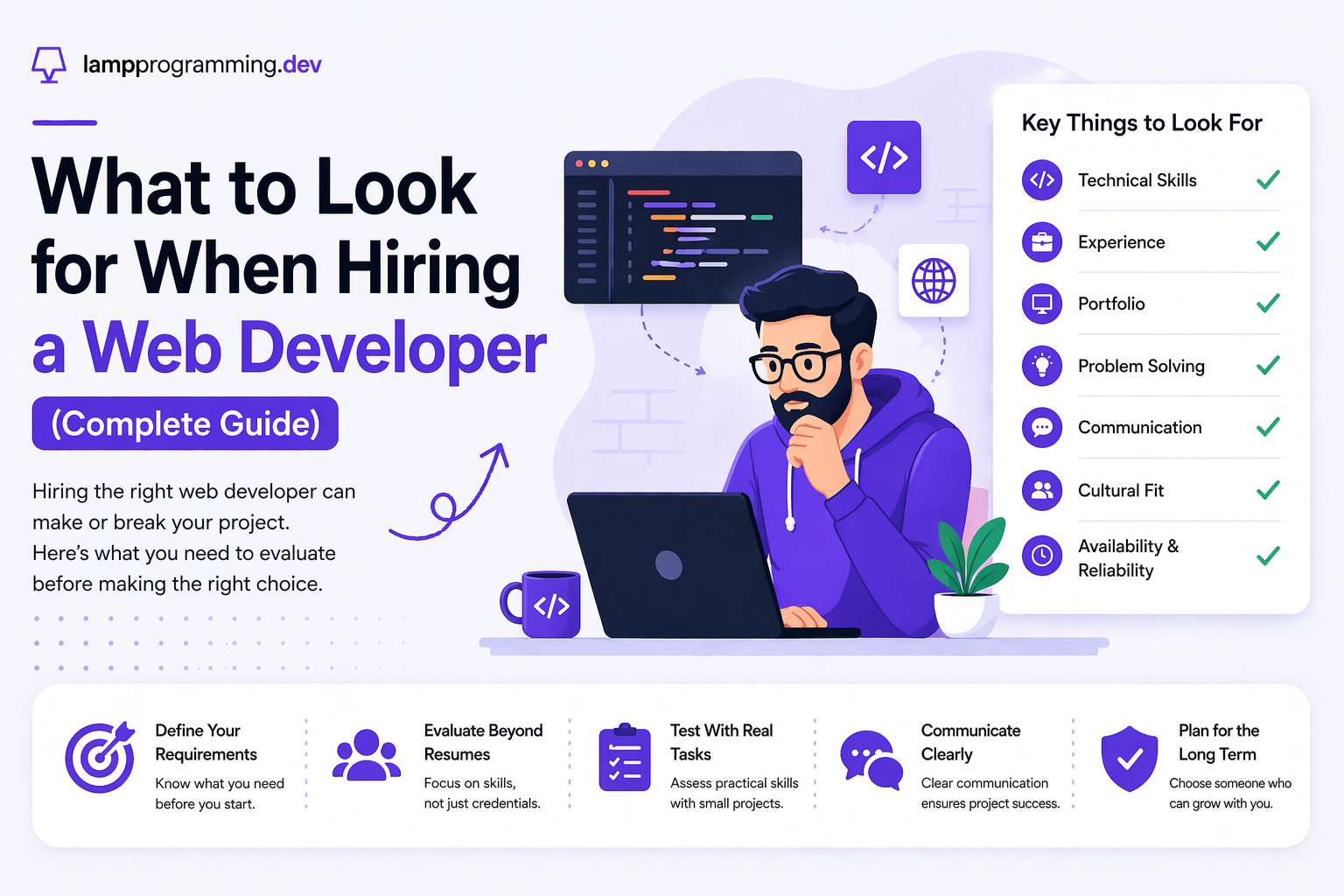
Hiring a web developer is one of the most consequential vendor decisions a small business can make. A bad hire costs you money twice — once to build it, and again to fix it. Here's how to evaluate developers before you sign anything.
Define What You Actually Need First
Before you talk to a single developer, write down:
- What kind of site or application do you need? (Marketing site, ecommerce, web app, CMS)
- What functionality is required? (Contact forms, payment processing, user accounts, API integrations)
- What's your timeline?
- What's your total budget, including post-launch support?
A developer who doesn't ask these questions in the first conversation is a red flag.
Freelancer vs Agency vs In-House
Freelancer
Cheaper upfront. Good for small, well-defined projects. Risk: availability gaps, single point of failure if they get sick or disappear, no team to escalate to.
Agency
Higher cost, but you get a team — designer, developer, project manager. Better for complex projects that need multiple skill sets. Look for agencies with a portfolio in your industry.
In-House
Only justified if you have enough ongoing development work to keep someone busy full-time. A mid-level full-stack developer costs $80,000–$130,000/year in salary, plus benefits, tools, and management overhead.
What to Look for in a Portfolio
Don't just look at screenshots. Open the actual sites in a browser and check:
- Does it load fast on mobile? (Use Google PageSpeed Insights — scores below 70 are a concern)
- Is the design clean and consistent, or does it look like default theme + plugins?
- Is there a contact form, booking system, or ecommerce flow you can test?
- Do they have case studies that explain the business problem they solved?
Questions to Ask in the Proposal Stage
- What's your tech stack, and why? — There's no single correct answer, but they should have a clear rationale, not just "that's what I know."
- Who owns the code and hosting after launch? — You should own both. Beware agencies that host on proprietary platforms with lock-in.
- How do you handle scope changes? — Every project has them. Their answer tells you how disputes will be managed.
- What does post-launch support look like? — Are there retainer options? Response time guarantees?
- Will I be able to update the site myself? — If you need a developer for every text change, budget for that.
- Can I speak with a recent client? — A developer who has nothing to hide will give you references without hesitation.
Red Flags to Watch For
- No written contract or statement of work
- Payment terms that require 100% upfront
- Vague deliverables — "a great website" is not a deliverable
- Reluctance to share who owns the source code
- No previous client references
- Portfolio with no live sites — only mockups or screenshots
- Promises of "SEO" with no explanation of what that means in practice
Contract Essentials
A professional development contract should include:
- Fixed scope with itemized deliverables
- Timeline with milestones and payment tied to them
- IP assignment clause — you own the code and design upon final payment
- Revision rounds included vs. billed separately
- Post-launch warranty period (typically 30–90 days)
- Termination clause in case the relationship breaks down
Price vs Value
The cheapest bid is rarely the best value. A developer who delivers a slow, hard-to-maintain site for $1,500 costs more than a developer who builds a fast, clean site for $5,000 — because the $1,500 site will need expensive fixes within a year.
Evaluate price relative to portfolio quality, communication speed, and contract clarity. Those three signals tell you more about a developer than hourly rate.
Ready to Grow Your Business Online?
LAMP Programming is a web development agency based in Santa Barbara, CA. We build fast, modern websites and ecommerce stores that generate real leads.
Frequently Asked Questions
- Look for a portfolio of live sites (not just mockups), a clear written contract, transparent pricing, and references from past clients. A developer who asks about your business goals before discussing design is a strong positive signal.
- Freelancers are cheaper for small, well-defined projects. Agencies are better for complex work that needs design, development, and project management together. The right choice depends on scope and your risk tolerance.
- A professionally built business website typically runs $4,000–$10,000. Ecommerce adds $5,000–$20,000 depending on complexity. Be wary of quotes under $1,500 — the hidden costs of a bad build usually exceed the savings.
- Red flags include no written contract, 100% upfront payment, vague deliverables, no client references, and reluctance to confirm who owns the source code after launch. Walk away from any developer who won't answer these directly.
- You should own the code, design, and domain upon final payment. Any reputable developer will include an IP assignment clause in the contract. Avoid agencies that host your site on proprietary platforms with lock-in.