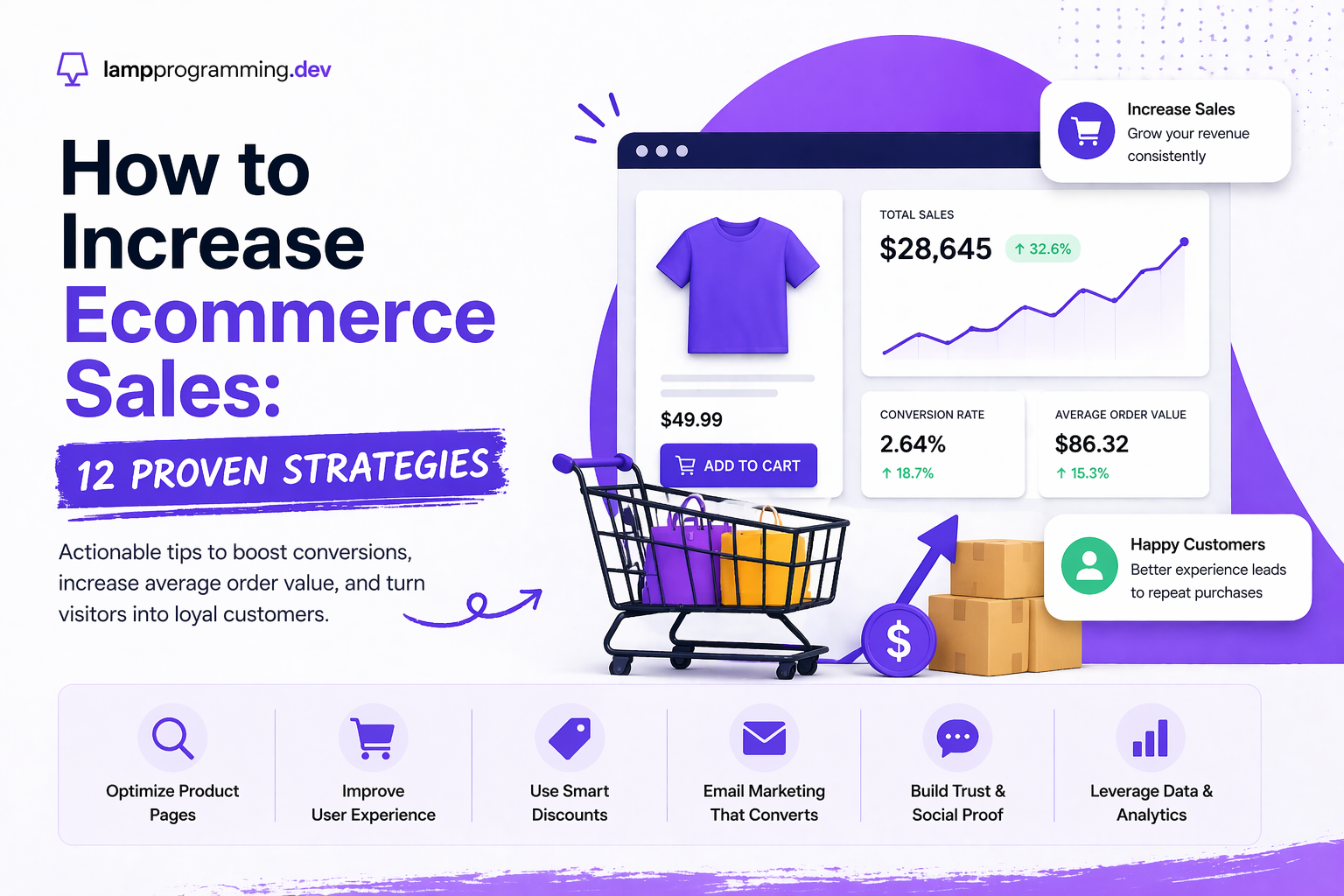
More traffic doesn't always mean more sales. Most ecommerce stores lose customers at every stage of the buying journey — and most of those losses are preventable. Here are 12 strategies that consistently move the revenue needle.
1. Fix Your Site Speed First
A one-second delay in page load time reduces conversions by 7%. Before you run ads or optimize your copy, make sure your store loads in under 3 seconds on mobile. Use Google PageSpeed Insights to find the biggest offenders — uncompressed images, render-blocking scripts, and slow server response times are the usual culprits.
2. Simplify Your Checkout Flow
Every additional step in checkout is a conversion leak. The best ecommerce checkouts have a single page: shipping info, payment info, and order confirmation. Remove account creation requirements for guest checkout. Every required field you add reduces completions.
3. Add Social Proof at the Right Moments
Reviews, ratings, and customer photos don't just build trust — they answer purchase objections in real time. Display reviews on product pages, not just on a dedicated reviews page. Show star ratings in search results using Review structured data. Add recent purchase notifications ("3 people bought this today") to create urgency.
4. Use Abandoned Cart Recovery
On average, 70% of shoppers who add an item to their cart don't complete the purchase. An automated email sequence — sent 1 hour, 24 hours, and 72 hours after abandonment — recovers 5–15% of those carts. This is one of the highest-ROI automations in ecommerce.
5. Write Product Descriptions That Sell
Product descriptions that list features instead of benefits leave money on the table. Instead of "12oz stainless steel tumbler," write "Keeps your coffee hot for 6 hours — designed for mornings that don't slow down." Speak to the outcome, not the specification.
6. Optimize Product Images
High-quality product photography is one of the most underinvested areas in ecommerce. Customers can't touch or try your product — images are the substitute. Include multiple angles, lifestyle shots, and zoom capability. For apparel, show the product on a person in multiple sizes.
7. Create Urgency Without Being Manipulative
Countdown timers on sales, low-stock indicators, and "order by 2pm for same-day shipping" messages all increase conversion when they're real. Fake countdown timers that reset on refresh erode trust the moment customers notice them. Use only genuine urgency signals.
8. Upsell and Cross-Sell Intelligently
Amazon attributes 35% of its revenue to its recommendation engine. On the product page, show "frequently bought together" bundles. In the cart, offer related accessories. In the post-purchase confirmation, offer a one-click add-on at a discount. Each touchpoint is a revenue opportunity.
9. Offer Free Shipping (With a Threshold)
Free shipping is the single most effective offer in ecommerce. If your margins allow it, offer free shipping on all orders. If not, set a minimum — "Free shipping on orders over $75" — and display the amount remaining in the cart ("Add $12 more for free shipping"). This increases average order value while meeting customer expectations.
10. Improve Your Search and Navigation
Customers who use on-site search convert at 2–3x the rate of customers who browse. A poor search experience — one that returns no results for common queries, or doesn't handle typos — pushes buyers to competitors. Implement predictive search, category filters, and a clear navigation hierarchy.
11. Build a Retargeting Strategy
Retargeting ads serve ads to people who visited your store but didn't purchase. These audiences are already familiar with your brand and convert at significantly higher rates than cold traffic. Google and Meta both offer retargeting audiences. Segment them — product viewers, cart abandoners, and past customers all warrant different messaging.
12. Make Returns Frictionless
A clear, generous return policy reduces purchase hesitation and increases conversion. Customers who know they can easily return a product are more willing to buy. Post your return policy prominently on product pages — not buried in the footer. Stores with "free 30-day returns" prominently displayed consistently outperform those that hide the policy.
The Common Thread
Every strategy above reduces friction, builds trust, or meets the customer where they are in the buying journey. Ecommerce optimization isn't about tricks — it's about removing the barriers between your customer and the purchase they already want to make.
Ready to Grow Your Business Online?
LAMP Programming is a web development agency based in Santa Barbara, CA. We build fast, modern websites and ecommerce stores that generate real leads.
Frequently Asked Questions
- The highest-impact improvements are site speed, checkout simplification, and abandoned cart recovery emails. These address the most common points where customers drop off before completing a purchase.
- A good ecommerce conversion rate is 1–4% from organic traffic and 0.5–2% from paid ads. Well-optimized stores with high-intent traffic can exceed these benchmarks significantly.
- A one-second delay in page load time reduces conversions by 7%. Slow sites also rank lower in Google, reducing the organic traffic you receive in the first place. Speed is both a conversion and an SEO problem.
- Automated emails sent 1 hour, 24 hours, and 72 hours after a cart is abandoned can recover 5–15% of those lost sales. This is one of the highest-ROI automations available to ecommerce businesses.
- Free shipping is the single most effective offer in ecommerce. If margins allow, offer it on all orders. Otherwise, set a threshold and display the remaining amount in the cart ("Add $12 more for free shipping") to increase average order value.