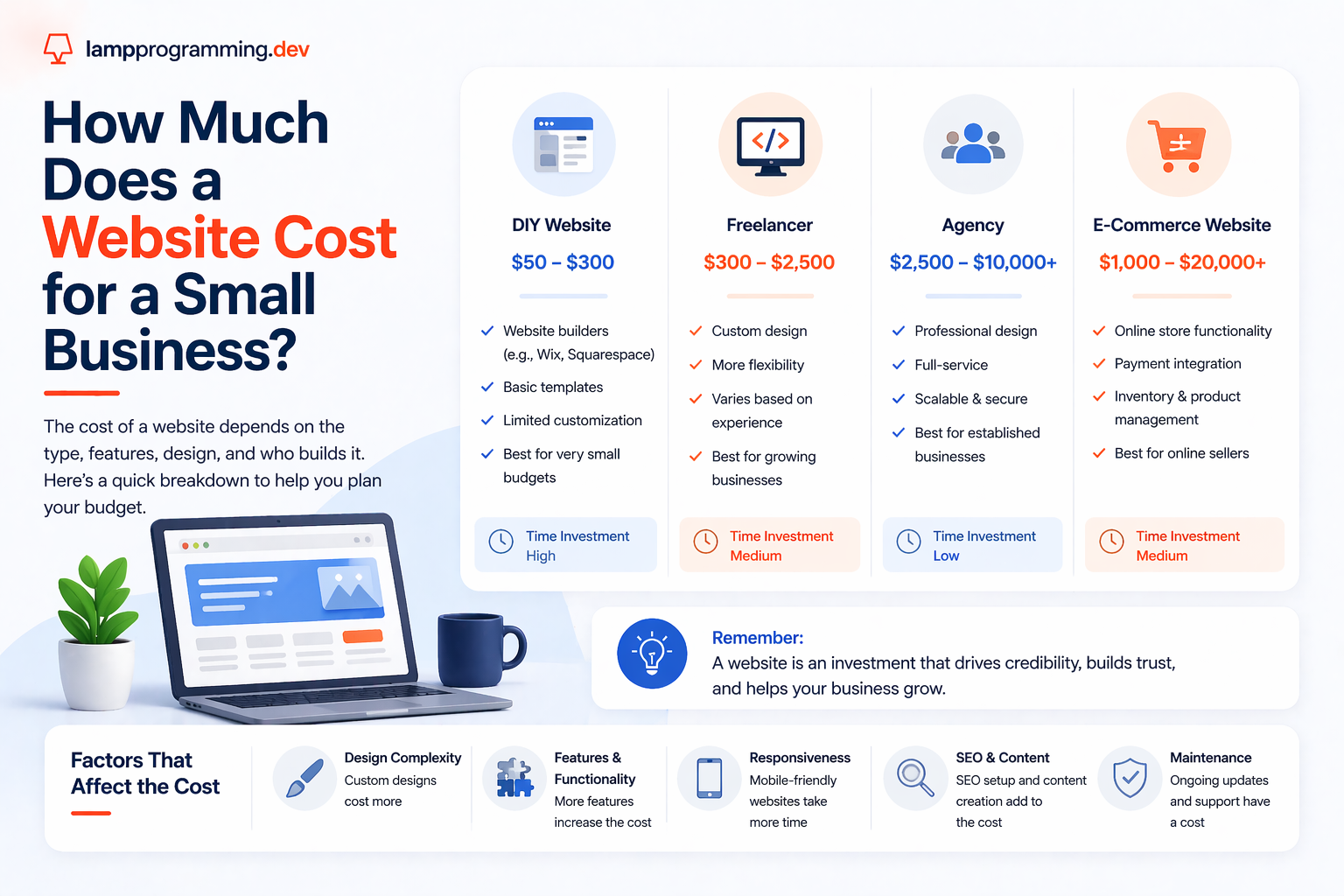
If you've started researching how much a website costs for a small business, you've probably found answers ranging from $500 to $100,000. That range is real — and here's why it exists.
The Three Tiers of Website Cost
1. Template-Based Websites ($500–$3,000)
Platforms like Squarespace, Wix, or WordPress with a premium theme let you launch quickly at a low upfront cost. These work for service businesses that just need an online presence — contact info, a few pages, and a booking form.
The trade-off: you're locked into someone else's design decisions, plugin dependencies can slow your site, and customization has hard limits.
2. Custom WordPress or Shopify Sites ($3,000–$15,000)
A professionally designed WordPress or Shopify site — built by a developer, not assembled with page builders — falls in this range. You get a unique design, better performance, and a cleaner codebase than a DIY build.
This is the right tier for most small businesses: local retailers, service companies, professional practices, and restaurants.
3. Fully Custom Web Applications ($15,000–$100,000+)
Custom-built platforms on frameworks like Laravel or Next.js cost more because they're engineered from scratch. Every feature, every database interaction, every API integration is written specifically for your business logic.
This tier makes sense for SaaS products, high-volume ecommerce stores, marketplaces, and businesses with workflows that no off-the-shelf tool can handle.
What Drives the Price Up
- Ecommerce functionality — product management, cart, checkout, payment gateways, and order management add significant scope.
- Custom design — a designer who creates wireframes and a unique visual identity adds $2,000–$8,000 to most projects.
- Third-party integrations — CRMs, ERPs, inventory systems, and booking platforms all require development time.
- Multilingual or multi-region support — translating content and adapting checkout flows for different markets adds complexity.
- Performance requirements — if you need a 90+ PageSpeed score and SSR for SEO, that requires more engineering than a standard CMS install.
Ongoing Costs to Budget For
The build price is not the full picture. Factor in:
- Hosting: $20–$200/month depending on traffic and infrastructure
- Domain: $10–$50/year
- SSL certificate: free with most hosts, or ~$100/year for EV certs
- Maintenance retainer: $200–$1,500/month for updates, monitoring, and new features
- Platform fees: Shopify charges 0.5%–2% transaction fees depending on your plan
How to Evaluate a Quote
When you receive proposals from developers, compare them on more than price. Ask:
- What is the tech stack, and who owns the code?
- Is there a fixed-price contract or hourly billing?
- What does post-launch support look like?
- Do you have examples of similar projects?
- What's the timeline, and what do you need from me to hit it?
A $3,000 quote from an experienced developer who has built similar sites is usually worth more than a $1,500 quote from someone learning on your project.
What You Actually Need to Spend
For most small businesses in 2025, a well-built website with good SEO, mobile optimization, and a contact form runs between $4,000 and $10,000. Ecommerce adds another $5,000–$20,000 depending on catalogue size and payment complexity.
The websites that generate real business — leads, bookings, sales — are built by people who understand both development and conversion. That combination has a price. But it pays for itself.
Ready to Grow Your Business Online?
LAMP Programming is a web development agency based in Santa Barbara, CA. We build fast, modern websites and ecommerce stores that generate real leads.
Frequently Asked Questions
- A custom small business website typically costs $3,000–$15,000 depending on complexity. Template-based sites can be built for $500–$3,000. Ecommerce functionality, custom design, and SEO work add to the cost.
- Website costs typically cover design, development, content, and launch. Ongoing costs include hosting ($10–$50/month), SSL, maintenance, and updates.
- Yes, if your website is a primary source of leads or revenue. Custom sites load faster, rank better on Google, and are built specifically for your business goals — not around a template's limitations.
- Monthly maintenance typically costs $100–$500 depending on the level of support, updates, and hosting included. Some agencies bundle this into a monthly retainer.